Last modified: Jan 31 2026 at 10:09 PM • 4 mins read
5. Longest Palindromic Substring
Table of contents
- Problem Description
- Approach
- Implementation
- Complexity Analysis
- Alternative Approaches
- Test Cases
- Key Insights
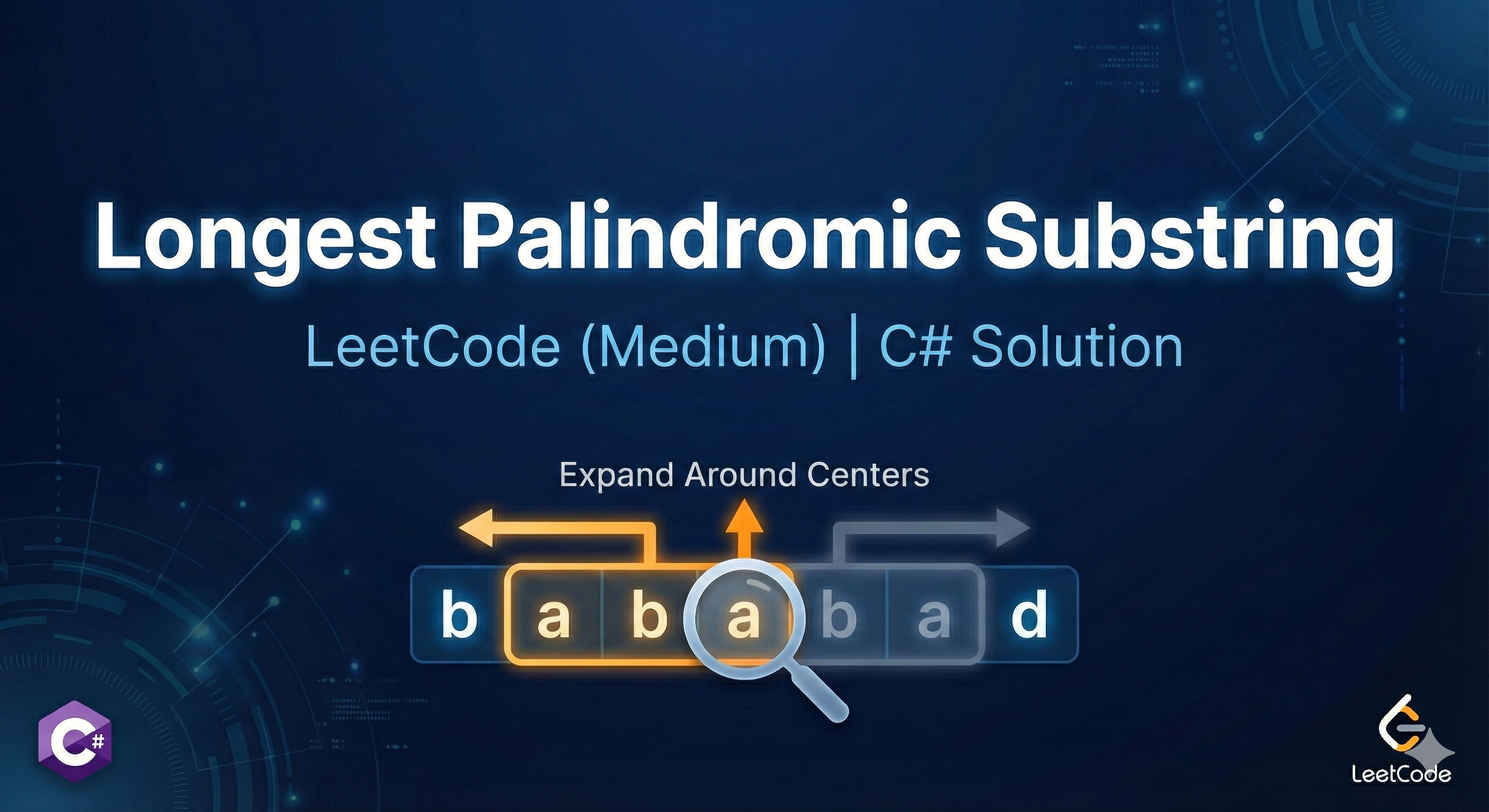
Problem Description
Given a string s, return the longest palindromic substring in s.
Example 1:
Input: s = "babad"
Output: "bab"
Explanation: "aba" is also a valid answer.
Example 2:
Input: s = "cbbd"
Output: "bb"
Constraints:
- $1 \leq \text{s.length} \leq 1000$
- $s$ consist of only digits and English letters.
LeetCode Link: 5. Longest Palindromic Substring
Approach
This problem can be solved using the “Expand Around Centers” technique. The key insight is that every palindrome has a center, and we can check all possible centers.
Strategy
- For each possible center in the string, expand outwards while characters match
- Handle both odd-length palindromes (single character center) and even-length palindromes (between two characters)
- Track the maximum length found and extract the corresponding substring
Algorithm Steps
- Find maximum length: For each position, expand around center to find the longest palindrome
- Handle two cases:
- Odd-length palindromes: center at $i$
- Even-length palindromes: center between $i$ and $i+1$
- Extract result: Once we know the maximum length, scan through the string to find the actual palindrome
Implementation
C# Solution
public class Solution {
    public string LongestPalindrome(string s) {
        var len = 1;

        // Find the maximum palindrome length
        for(var i = 0; i < s.Length; ++i) {
            // Check odd-length palindromes (center at i)
            len = Math.Max(len, Expand(s, i, i));

            // Check even-length palindromes (center between i and i+1)
            if(i < s.Length - 1) {
                len = Math.Max(len, Expand(s, i, i + 1));
            }
        }

        // Find the actual palindrome with the maximum length
        for(var i = 0; i <= s.Length - len; ++i) {
            if(IsPalindromic(s, i, i + len - 1)) {
                return s.Substring(i, len);
            }
        }

        return "";
    }

    // Check if substring from index i to j is palindromic
    private bool IsPalindromic(string s, int i, int j) {
        while(i <= j) {
            if(s[i] != s[j]) return false;
            ++i;
            --j;
        }
        return true;
    }

    // Expand around center and return the length of palindrome
    private int Expand(string s, int i, int j) {
        var res = 0;
        while(i >= 0 && j < s.Length && s[i] == s[j]) {
            res = j - i + 1;
            --i;
            ++j;
        }
        return res;
    }
}
Complexity Analysis
Time Complexity: $O(n^2)$
- We check each of the $n$ positions as potential centers
- For each center, we expand outwards in the worst case $O(n)$ times
- The final scan to extract the palindrome is also $O(n)$
- Overall: $O(n^2)$
Space Complexity: $O(1)$
- We only use a constant amount of extra space for variables
- The input string is not modified
- No additional data structures are needed
Alternative Approaches
1. Brute Force - $O(n^3)$
Check every possible substring to see if it’s a palindrome.
2. Dynamic Programming - $O(n^2)$ time, $O(n^2)$ space
Use a 2D table to store whether substring $s[i:j]$ is a palindrome.
3. Manacher’s Algorithm - $O(n)$ time
Advanced algorithm that can solve this in linear time, but much more complex to implement.
Test Cases
// Test Case 1: Basic example
Input: "babad"
Expected: "bab" or "aba"

// Test Case 2: Even-length palindrome
Input: "cbbd"
Expected: "bb"

// Test Case 3: Single character
Input: "a"
Expected: "a"

// Test Case 4: No palindrome longer than 1
Input: "abcdef"
Expected: "a" (or any single character)

// Test Case 5: Entire string is palindrome
Input: "racecar"
Expected: "racecar"

// Test Case 6: Multiple palindromes
Input: "abacabad"
Expected: "abacaba"
Key Insights
- Two types of centers: Remember to check both odd and even-length palindromes
- Expand around center: This technique is more intuitive than DP for this problem
- Early termination: The solution finds the maximum length first, then locates the actual substring
- Edge cases: Handle single characters and empty strings properly