Last modified: Jan 31 2026 at 10:09 PM • 8 mins read
Derivatives of Activation Functions
Table of contents
- Introduction
- Notation
- 1. Sigmoid Function Derivative
- 2. Tanh Function Derivative
- 3. ReLU Function Derivative
- 4. Leaky ReLU Function Derivative
- Summary Table
- Comparison of Gradient Properties
- Complete Implementation Example
- Why We Need These Derivatives
- Key Takeaways
![Derivatives of Activation Functions infographic showing four window panels comparing Sigmoid, Tanh, ReLU, and Leaky ReLU functions. Each panel displays a graph with the function curve in blue and derivative formula. Sigmoid panel shows S-curve from 0 to 1 with derivative g'(z) = a(1-a) and red X marking Vanishing Gradient problem. Tanh panel shows S-curve from -1 to 1 with derivative g'(z) = 1-a² and red X for Vanishing Gradient. ReLU panel shows piecewise linear function with flat line for z<0 and diagonal line for z>0, derivative g'(z) = 1 if z>0 else 0, with green checkmark for No Vanishing Gradient (for z>0). Leaky ReLU panel shows similar piecewise linear with slight negative slope for z<0, derivative g'(z) = 1 if z>0 else alpha, with green checkmark for No Dying ReLU. Bottom of infographic shows neural network diagram with arrow pointing to backpropagation formula: partial derivative of L with respect to z[l] equals partial derivative of L with respect to a[l] times g'(z[l]), labeled as Essential for BACKPROPAGATION in bold text.](/assets/images/deep-learning/neural-networks/week-3/derivatives_of_activation_functions.png)
Introduction
To implement backpropagation for training neural networks, we need to compute the derivatives (slopes) of activation functions. This lesson covers how to calculate derivatives for the most common activation functions used in neural networks.
Notation
Derivative Notation
For an activation function $g(z)$, we use multiple equivalent notations for its derivative:
\[\frac{d}{dz} g(z) = g'(z) = \frac{dg}{dz}\]where:
- $g’(z)$ is called “g prime of z” (common shorthand)
- Represents the slope of $g(z)$ at point $z$
In Terms of Activations
If $a = g(z)$, we can often express $g’(z)$ in terms of $a$:
\[g'(z) = f(a)\]This is computationally efficient because we’ve already computed $a$ during forward propagation!
1. Sigmoid Function Derivative
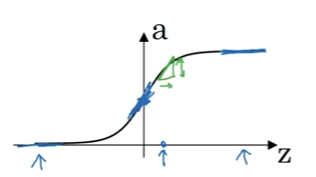
Function
\[g(z) = \sigma(z) = \frac{1}{1 + e^{-z}}\]Derivative Formula
\[g'(z) = \frac{d}{dz} \sigma(z) = g(z) \cdot (1 - g(z))\]Or equivalently, since $a = g(z)$:
\[g'(z) = a \cdot (1 - a)\]Verification at Key Points
Let’s verify this formula makes sense:
Case 1: $z = 10$ (very large)
\[g(10) \approx 1\] \[g'(10) = 1 \cdot (1 - 1) = 0 \quad \checkmark\]✅ Correct! The sigmoid function is flat (slope ≈ 0) for large positive $z$.
Case 2: $z = -10$ (very small)
\[g(-10) \approx 0\] \[g'(-10) = 0 \cdot (1 - 0) = 0 \quad \checkmark\]✅ Correct! The sigmoid function is also flat for large negative $z$.
Case 3: $z = 0$ (middle)
\[g(0) = 0.5\] \[g'(0) = 0.5 \cdot (1 - 0.5) = 0.25 \quad \checkmark\]✅ Correct! Maximum slope occurs at $z = 0$.
Implementation
def sigmoid(z):
    """Sigmoid activation function"""
    return 1 / (1 + np.exp(-z))

def sigmoid_derivative(z):
    """Derivative of sigmoid function"""
    a = sigmoid(z)
    return a * (1 - a)

# Alternative: if you already have 'a' computed
def sigmoid_derivative_from_a(a):
    """Derivative using already-computed activation"""
    return a * (1 - a)
Gradient Flow Characteristics
Problem: Sigmoid has vanishing gradient issue
- When $|z|$ is large, $g’(z) \approx 0$
- Gradient becomes very small, slowing learning
- Maximum derivative is only $0.25$ at $z = 0$
2. Tanh Function Derivative
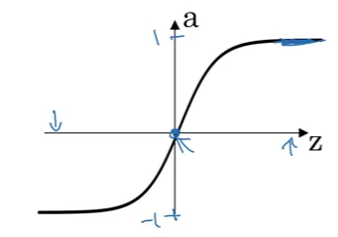
Function
\[g(z) = \tanh(z) = \frac{e^z - e^{-z}}{e^z + e^{-z}}\]Range: $(-1, 1)$
Derivative Formula
\[g'(z) = \frac{d}{dz} \tanh(z) = 1 - (g(z))^2\]Or equivalently, since $a = g(z)$:
\[g'(z) = 1 - a^2\]Verification at Key Points
Case 1: $z = 10$ (very large)
\[\tanh(10) \approx 1\] \[g'(10) = 1 - 1^2 = 0 \quad \checkmark\]✅ Function is flat for large positive $z$.
Case 2: $z = -10$ (very small)
\[\tanh(-10) \approx -1\] \[g'(-10) = 1 - (-1)^2 = 1 - 1 = 0 \quad \checkmark\]✅ Function is flat for large negative $z$.
Case 3: $z = 0$ (middle)
\[\tanh(0) = 0\] \[g'(0) = 1 - 0^2 = 1 \quad \checkmark\]✅ Maximum slope occurs at $z = 0$.
Implementation
def tanh(z):
    """Hyperbolic tangent activation function"""
    return np.tanh(z)

def tanh_derivative(z):
    """Derivative of tanh function"""
    a = np.tanh(z)
    return 1 - a**2

# Alternative: if you already have 'a' computed
def tanh_derivative_from_a(a):
    """Derivative using already-computed activation"""
    return 1 - a**2
Gradient Flow Characteristics
Better than sigmoid but still has issues:
- Maximum derivative is $1$ at $z = 0$ (better than sigmoid’s $0.25$)
Still suffers from vanishing gradient for $ z $ large - Zero-centered outputs help with gradient flow
3. ReLU Function Derivative
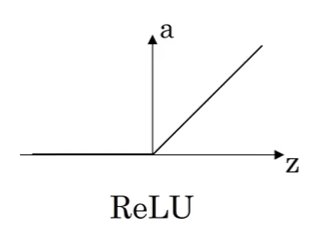
Function
\[g(z) = \text{ReLU}(z) = \max(0, z) = \begin{cases} z & \text{if } z > 0 \\ 0 & \text{if } z \leq 0 \end{cases}\]Derivative Formula
\[g'(z) = \begin{cases} 1 & \text{if } z > 0 \\ 0 & \text{if } z < 0 \\ \text{undefined} & \text{if } z = 0 \end{cases}\]Handling the Discontinuity at $z = 0$
Mathematical Issue: Derivative is technically undefined at $z = 0$.
Practical Solution: In implementation, set $g’(0)$ to either $0$ or $1$ - it doesn’t matter!
Why it doesn’t matter:
- The probability of $z$ being exactly $0.000000…$ is infinitesimally small
- For optimization experts: $g’$ becomes a sub-gradient, and gradient descent still works
- In practice, this choice has negligible impact on training
Common convention: Set $g’(0) = 1$
Implementation
def relu(z):
    """ReLU activation function"""
    return np.maximum(0, z)

def relu_derivative(z):
    """Derivative of ReLU function"""
    return (z > 0).astype(float)
    # Returns 1 where z > 0, and 0 where z <= 0

# Alternative explicit form
def relu_derivative_explicit(z):
    """Derivative of ReLU - explicit conditionals"""
    dz = np.zeros_like(z)
    dz[z > 0] = 1
    return dz
Gradient Flow Characteristics
Advantages:
- ✅ No vanishing gradient for $z > 0$ (gradient = 1)
- ✅ Computationally efficient
- ✅ Sparse activation (many neurons output 0)
Disadvantages:
- ❌ “Dying ReLU” problem: neurons with $z < 0$ have zero gradient
- ❌ Not differentiable at $z = 0$
4. Leaky ReLU Function Derivative
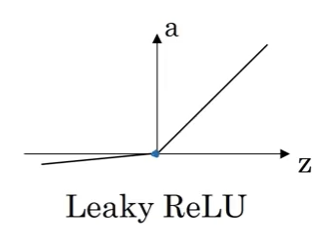
Function
\[g(z) = \text{Leaky ReLU}(z) = \max(\alpha z, z) = \begin{cases} z & \text{if } z > 0 \\ \alpha z & \text{if } z \leq 0 \end{cases}\]where $\alpha$ is a small constant (typically $\alpha = 0.01$)
Derivative Formula
\[g'(z) = \begin{cases} 1 & \text{if } z > 0 \\ \alpha & \text{if } z < 0 \\ \text{undefined} & \text{if } z = 0 \end{cases}\]Handling the Discontinuity
Same as ReLU: set $g’(0)$ to either $\alpha$ or $1$ - it doesn’t matter in practice.
Common convention: Set $g’(0) = 1$
Implementation
def leaky_relu(z, alpha=0.01):
    """Leaky ReLU activation function"""
    return np.maximum(alpha * z, z)

def leaky_relu_derivative(z, alpha=0.01):
    """Derivative of Leaky ReLU function"""
    dz = np.ones_like(z)
    dz[z < 0] = alpha
    return dz

# Alternative vectorized form
def leaky_relu_derivative_vectorized(z, alpha=0.01):
    """Derivative - vectorized version"""
    return np.where(z > 0, 1, alpha)
Gradient Flow Characteristics
Advantages over ReLU:
- ✅ No “dying ReLU” problem - gradient is $\alpha$ (not 0) for $z < 0$
- ✅ Allows negative values to have small gradient
- ✅ All benefits of ReLU plus gradient flow for negative values
Summary Table
| Activation | Function | Derivative $g’(z)$ | Derivative in terms of $a$ | At $z=0$ |
|---|---|---|---|---|
| Sigmoid | $\frac{1}{1+e^{-z}}$ | $g(z)(1-g(z))$ | $a(1-a)$ | $0.25$ |
| Tanh | $\frac{e^z-e^{-z}}{e^z+e^{-z}}$ | $1-(g(z))^2$ | $1-a^2$ | $1$ |
| ReLU | $\max(0,z)$ | $\begin{cases} 1 & z>0 \ 0 & z\leq0 \end{cases}$ | N/A | $0$ or $1$ |
| Leaky ReLU | $\max(\alpha z,z)$ | $\begin{cases} 1 & z>0 \ \alpha & z\leq0 \end{cases}$ | N/A | $\alpha$ or $1$ |
Comparison of Gradient Properties
Maximum Gradient Values
\[\max g'(z) = \begin{cases} 0.25 & \text{Sigmoid} \\ 1 & \text{Tanh} \\ 1 & \text{ReLU} \\ 1 & \text{Leaky ReLU} \end{cases}\]Implication: Sigmoid’s small maximum gradient makes it slowest to train.
Vanishing Gradient Problem
Affected: Sigmoid, Tanh
Gradients approach 0 for $ z $ large - Slows learning significantly
Not affected: ReLU, Leaky ReLU
- Constant gradient for positive values
- Faster training in practice
Complete Implementation Example
import numpy as np

class ActivationFunctions:
    """Collection of activation functions and their derivatives"""

    @staticmethod
    def sigmoid(z):
        return 1 / (1 + np.exp(-z))

    @staticmethod
    def sigmoid_derivative(a):
        """Derivative using already-computed activation"""
        return a * (1 - a)

    @staticmethod
    def tanh(z):
        return np.tanh(z)

    @staticmethod
    def tanh_derivative(a):
        """Derivative using already-computed activation"""
        return 1 - a**2

    @staticmethod
    def relu(z):
        return np.maximum(0, z)

    @staticmethod
    def relu_derivative(z):
        return (z > 0).astype(float)

    @staticmethod
    def leaky_relu(z, alpha=0.01):
        return np.maximum(alpha * z, z)

    @staticmethod
    def leaky_relu_derivative(z, alpha=0.01):
        dz = np.ones_like(z)
        dz[z < 0] = alpha
        return dz

# Example usage
z = np.array([-2, -1, 0, 1, 2])
act = ActivationFunctions()

print("Sigmoid:")
print("  Values:", act.sigmoid(z))
print("  Derivatives:", act.sigmoid_derivative(act.sigmoid(z)))

print("\nTanh:")
print("  Values:", act.tanh(z))
print("  Derivatives:", act.tanh_derivative(act.tanh(z)))

print("\nReLU:")
print("  Values:", act.relu(z))
print("  Derivatives:", act.relu_derivative(z))

print("\nLeaky ReLU:")
print("  Values:", act.leaky_relu(z))
print("  Derivatives:", act.leaky_relu_derivative(z))
Why We Need These Derivatives
During backpropagation, we compute gradients by applying the chain rule:
\[\frac{\partial \mathcal{L}}{\partial z^{[l]}} = \frac{\partial \mathcal{L}}{\partial a^{[l]}} \cdot \frac{\partial a^{[l]}}{\partial z^{[l]}}\]where $\frac{\partial a^{[l]}}{\partial z^{[l]}} = g’(z^{[l]})$ is the activation function derivative!
These derivatives are essential for:
- Computing gradients in backpropagation
- Updating weights and biases
- Training the neural network
Key Takeaways
- Derivative notation: $g’(z) = \frac{d}{dz} g(z)$ represents the slope of activation function
- Sigmoid derivative: $g’(z) = a(1-a)$ - convenient to compute from activation
- Tanh derivative: $g’(z) = 1 - a^2$ - also convenient to compute from activation
- ReLU derivative: $g’(z) = 1$ if $z > 0$, else $0$ - simple to compute
- Leaky ReLU derivative: $g’(z) = 1$ if $z > 0$, else $\alpha$ - fixes dying ReLU
- Discontinuity at zero: For ReLU variants, set $g’(0)$ to any value (doesn’t matter)
- Vanishing gradient: Sigmoid and tanh suffer from this; ReLU variants don’t
- Computational efficiency: Express derivatives in terms of $a$ to reuse computed values
- Sub-gradient: Technical term for derivatives at non-differentiable points
- Essential for backpropagation: These derivatives enable gradient descent training