Last modified: Jan 31 2026 at 10:09 PM • 6 mins read
Activation Functions
Table of contents
- Introduction
- What is an Activation Function?
- Common Activation Functions
- Comparison Table
- Practical Guidelines
- Choosing the Right Activation Function
- Implementation Example
- Key Takeaways
Introduction
When building a neural network, one of the key decisions you need to make is choosing the activation function for hidden layers and the output layer. So far, we’ve only used the sigmoid function, but several other options often work much better. Let’s explore the most common activation functions and learn when to use each one.
What is an Activation Function?
In forward propagation, we compute:
\[z^{[l]} = W^{[l]} a^{[l-1]} + b^{[l]}\] \[a^{[l]} = g^{[l]}(z^{[l]})\]The function $g(z)$ is called the activation function. It introduces non-linearity into the network, allowing it to learn complex patterns.
Common Activation Functions
1. Sigmoid Function
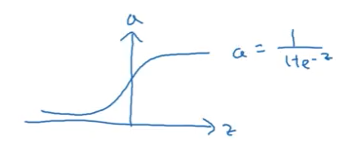
Formula:
\[\sigma(z) = \frac{1}{1 + e^{-z}}\]Range: $(0, 1)$
Graph: S-shaped curve
Pros:
- Output is between 0 and 1
- Good for binary classification output layer
- Smooth gradient
Cons:
- ❌ Vanishing gradient problem (gradient near 0 for large/small $z$)
- ❌ Outputs not zero-centered (mean around 0.5)
- ❌ Slow convergence
When to use:
- ✅ Output layer for binary classification only
- ❌ Almost never use for hidden layers
2. Hyperbolic Tangent (tanh)
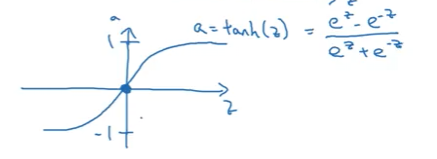
Formula:
\[\tanh(z) = \frac{e^z - e^{-z}}{e^z + e^{-z}}\]Range: $(-1, 1)$
Graph: S-shaped curve, shifted version of sigmoid
Pros:
- Zero-centered (mean around 0)
- Better than sigmoid for hidden layers
- Data centering effect helps next layer learn faster
Cons:
- ❌ Still has vanishing gradient problem
- ❌ Computationally more expensive than ReLU
When to use:
- ✅ Hidden layers (better than sigmoid)
- ❌ Not recommended over ReLU in most cases
Why better than sigmoid?
By outputting values between -1 and 1 (instead of 0 and 1), tanh centers the data around zero. This makes learning easier for the next layer, similar to how normalizing input data helps training.
3. ReLU (Rectified Linear Unit)
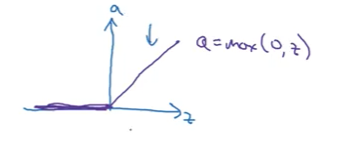
Formula:
\[\text{ReLU}(z) = \max(0, z) = \begin{cases} z & \text{if } z > 0 \\ 0 & \text{if } z \leq 0 \end{cases}\]Range: $[0, \infty)$
Graph: Linear for positive values, zero for negative
Pros:
- ✅ No vanishing gradient for positive values
- ✅ Computationally efficient (simple max operation)
- ✅ Fast convergence in practice
- ✅ Most popular choice today
Cons:
- ❌ “Dying ReLU” - gradient is 0 when $z < 0$
- ❌ Not zero-centered
When to use:
- ✅ Default choice for hidden layers
- ✅ Use this if you’re unsure
Implementation note:
The derivative at $z = 0$ is technically undefined, but in practice, you can treat it as either 0 or 1 - it makes negligible difference since the probability of exactly hitting 0 is infinitesimally small.
4. Leaky ReLU
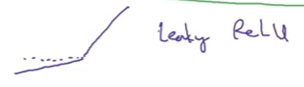
Formula:
\[\text{Leaky ReLU}(z) = \max(0.01z, z) = \begin{cases} z & \text{if } z > 0 \\ 0.01z & \text{if } z \leq 0 \end{cases}\]Range: $(-\infty, \infty)$
Graph: Linear for positive, small slope (0.01) for negative
Pros:
- ✅ Fixes “dying ReLU” problem
- ✅ Never has zero gradient
- ✅ All benefits of ReLU plus gradient flow for negative values
Cons:
- Less commonly used than ReLU (but often performs better)
When to use:
- ✅ Alternative to ReLU
- ✅ Try if ReLU isn’t working well
Variations:
- The slope parameter (0.01) can be learned during training (called Parametric ReLU or PReLU)
- Some practitioners report better results, but it’s less common in practice
Comparison Table
| Activation | Formula | Range | Hidden Layer | Output Layer | Pros | Cons |
|---|---|---|---|---|---|---|
| Sigmoid | $\frac{1}{1+e^{-z}}$ | (0, 1) | ❌ Avoid | ✅ Binary classification | Smooth, probabilistic output | Vanishing gradient, not zero-centered |
| Tanh | $\frac{e^z-e^{-z}}{e^z+e^{-z}}$ | (-1, 1) | ⚠️ OK | ❌ Rarely | Zero-centered | Vanishing gradient |
| ReLU | $\max(0, z)$ | [0, ∞) | ✅ Default | ❌ No | Fast, efficient, no vanishing gradient | Dying ReLU problem |
| Leaky ReLU | $\max(0.01z, z)$ | (-∞, ∞) | ✅ Good | ❌ No | Fixes dying ReLU | Less popular |
Practical Guidelines
Rule of Thumb
- Output Layer:
- Binary classification → Sigmoid
- Multi-class classification → Softmax (covered later)
- Regression → Linear (no activation) or ReLU
- Hidden Layers:
- Default choice → ReLU
- If ReLU doesn’t work well → Try Leaky ReLU
- Rarely → tanh
- Almost never → sigmoid
Why ReLU Works So Well
Despite having zero gradient for negative values, ReLU works because:
- In practice, enough hidden units have $z > 0$
- Learning remains fast for most training examples
- The non-saturating gradient (gradient = 1 for $z > 0$) accelerates convergence
Layer-Specific Activation Functions
You can (and often should) use different activation functions for different layers:
Example for binary classification:
# Hidden layer 1
Z1 = np.dot(W1, X) + b1
A1 = relu(Z1)                    # ReLU

# Hidden layer 2
Z2 = np.dot(W2, A1) + b2
A2 = relu(Z2)                    # ReLU

# Output layer
Z3 = np.dot(W3, A2) + b3
A3 = sigmoid(Z3)                 # Sigmoid for binary classification
Notation: Use superscripts to denote layer-specific functions: $g^{[1]}(z)$ vs $g^{[2]}(z)$
Choosing the Right Activation Function
The Pragmatic Approach
It’s often difficult to know in advance which activation function will work best for your specific problem. Best practice:
- Start with ReLU as the default for hidden layers
- Try multiple options: ReLU, Leaky ReLU, tanh
- Evaluate on validation set to see which performs best
- Iterate and experiment - no universal rule applies to all problems
Key insight: Deep learning involves many architectural choices (activation functions, number of units, initialization, etc.). Experimentation and empirical validation are essential parts of the process.
Future-Proofing Your Skills
Rather than memorizing “always use ReLU,” understand the trade-offs:
- What problems does each function solve?
- What are the computational costs?
- How do they affect gradient flow?
This knowledge helps you adapt to:
- New problem domains
- Evolving best practices
- Novel architectures
Implementation Example
import numpy as np

def sigmoid(z):
    """Sigmoid activation: (0, 1)"""
    return 1 / (1 + np.exp(-z))

def tanh(z):
    """Hyperbolic tangent: (-1, 1)"""
    return np.tanh(z)

def relu(z):
    """ReLU activation: [0, ∞)"""
    return np.maximum(0, z)

def leaky_relu(z, alpha=0.01):
    """Leaky ReLU activation: (-∞, ∞)"""
    return np.maximum(alpha * z, z)

# Example usage
z = np.array([-2, -1, 0, 1, 2])

print("Sigmoid:", sigmoid(z))
# [0.119, 0.268, 0.5, 0.731, 0.881]

print("Tanh:", tanh(z))
# [-0.964, -0.762, 0, 0.762, 0.964]

print("ReLU:", relu(z))
# [0, 0, 0, 1, 2]

print("Leaky ReLU:", leaky_relu(z))
# [-0.02, -0.01, 0, 1, 2]
Key Takeaways
- Activation functions introduce non-linearity into neural networks
- Sigmoid: Use only for binary classification output layer
- Tanh: Better than sigmoid for hidden layers but still has vanishing gradient
- ReLU: Default choice for hidden layers - fast, efficient, widely used
- Leaky ReLU: Fixes dying ReLU problem, worth trying
- Different layers can use different activations: ReLU for hidden, sigmoid for output
- Vanishing gradient problem: Sigmoid and tanh suffer from this, ReLU doesn’t (for $z > 0$)
- Experiment and validate: Try multiple activation functions on your validation set
- No universal best choice: What works depends on your specific problem
- Default recommendation: Start with ReLU for hidden layers