Last modified: Jan 31 2026 at 10:09 PM • 4 mins read
Gradient Descent
Table of contents
- Introduction
- Visualizing Gradient Descent
- How Gradient Descent Works
- Understanding the Derivative
- Full Gradient Descent for Logistic Regression
- Understanding Notation: $d$ vs $\partial$
- Implementation Summary
- Key Takeaways
Introduction
Now that we have defined the cost function $J(w, b)$, we need an algorithm to minimize it and learn the optimal parameters $w$ and $b$. This algorithm is called gradient descent.
Recap:
\[J(w, b) = -\frac{1}{m} \sum_{i=1}^{m} \left[y^{(i)} \log(\hat{y}^{(i)}) + (1-y^{(i)}) \log(1-\hat{y}^{(i)})\right]\]Goal: Find $w$ and $b$ that minimize $J(w, b)$.
Visualizing Gradient Descent
The Cost Function Surface
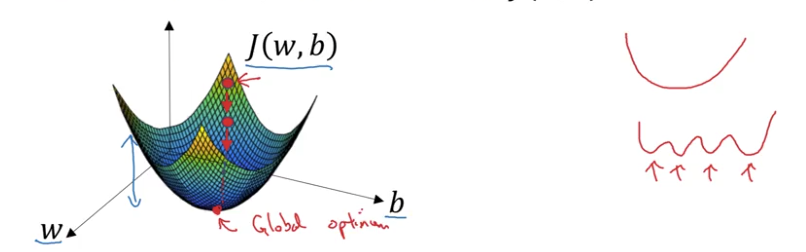
Imagine the cost function as a 3D surface:
- Horizontal axes: Parameters $w$ and $b$
- (In practice, $w$ can be high-dimensional, but we’ll use 1D for visualization)
- Vertical axis: Value of $J(w, b)$
- Surface height: The cost at each point
Convex vs Non-Convex Functions
Convex function (our logistic regression cost):
- Single “bowl” shape
- One global minimum
- No local minima
Non-convex function:
- Multiple “hills and valleys”
- Many local minima
- Harder to optimize
Why this matters: Our cost function $J(w, b)$ is convex, which is why we chose this particular function. This guarantees we can find the global minimum.
How Gradient Descent Works
The Algorithm
Step 1: Initialize
- Start with initial values for $w$ and $b$ (usually $w = 0$, $b = 0$)
- Because the function is convex, initialization doesn’t matter much
Step 2: Repeat until convergence
- Take a step in the steepest downhill direction
- Move toward lower cost
- Each step brings us closer to the minimum
Step 3: Converge
- Eventually reach the global minimum (or very close to it)
Mathematical Update Rule
For a simplified 1D case (just parameter $w$):
\[w := w - \alpha \frac{dJ(w)}{dw}\]Where:
- $:=$ means “update” or “assign”
- $\alpha$ is the learning rate (controls step size)
- $\frac{dJ(w)}{dw}$ is the derivative (slope of the cost function)
Code convention: We use dw as the variable name for $\frac{dJ(w)}{dw}$
w = w - alpha * dw
Understanding the Derivative
What is a Derivative?
The derivative $\frac{dJ(w)}{dw}$ represents the slope of the cost function at the current point.
Intuition:
- Slope = height / width of the tangent line
- Tells us which direction is “downhill”
- Tells us how steep the slope is
How the Update Works
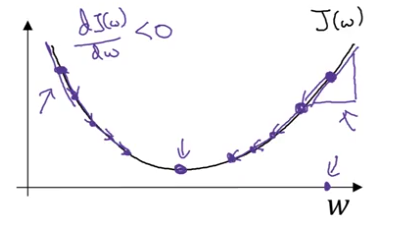
Case 1: Positive slope (derivative > 0)
- If $w$ is to the right of the minimum
- Derivative is positive
- $w := w - \alpha \times (\text{positive}) = w - \text{positive}$
- $w$ decreases → moves left toward minimum
Case 2: Negative slope (derivative < 0)
- If $w$ is to the left of the minimum
- Derivative is negative
- $w := w - \alpha \times (\text{negative}) = w + \text{positive}$
- $w$ increases → moves right toward minimum
Result: Regardless of where you start, gradient descent moves you toward the minimum.
Full Gradient Descent for Logistic Regression
For logistic regression with parameters $w$ and $b$:
Update rules:
\[w := w - \alpha \frac{\partial J(w,b)}{\partial w}\] \[b := b - \alpha \frac{\partial J(w,b)}{\partial b}\]Code convention:
w = w - alpha * dw  # dw represents ∂J/∂w
b = b - alpha * db  # db represents ∂J/∂b
Understanding Notation: $d$ vs $\partial$
The Confusing Calculus Notation
Single variable (one parameter):
- Use regular $d$: $\frac{dJ(w)}{dw}$
Multiple variables (two or more parameters):
- Use partial derivative $\partial$: $\frac{\partial J(w,b)}{\partial w}$
Important: They mean almost the same thing! Both represent the slope with respect to one variable.
Why This Notation Exists
The rule is:
- $J(w)$ → use $\frac{d}{dw}$ (ordinary derivative)
- $J(w, b)$ → use $\frac{\partial}{\partial w}$ (partial derivative)
Don’t worry too much about this distinction - both measure the slope in one direction.
Implementation Summary
In code, we use these conventions:
| Mathematical Notation | Code Variable | Meaning |
|---|---|---|
| $\frac{\partial J(w,b)}{\partial w}$ | dw | Amount to update $w$ |
| $\frac{\partial J(w,b)}{\partial b}$ | db | Amount to update $b$ |
| $\alpha$ | alpha or learning_rate | Step size |
Update step:
# Compute gradients (we'll learn how in next lessons)
dw = compute_gradient_w(...)
db = compute_gradient_b(...)

# Update parameters
w = w - alpha * dw
b = b - alpha * db
Key Takeaways
- Gradient descent finds the minimum of the cost function
- The derivative (slope) tells us which direction to move
- The learning rate $\alpha$ controls how big each step is
- We repeat the update until convergence
- Because $J(w,b)$ is convex, we always reach the global minimum