Last modified: Jan 31 2026 at 10:09 PM • 7 mins read
Regularization
Table of contents
- Introduction
- L2 Regularization for Logistic Regression
- L1 vs L2 Regularization
- The Regularization Parameter $\lambda$
- L2 Regularization for Neural Networks
- Implementing Regularized Gradient Descent
- Why It’s Called “Weight Decay”
- Implementation Summary
- Key Takeaways
Introduction
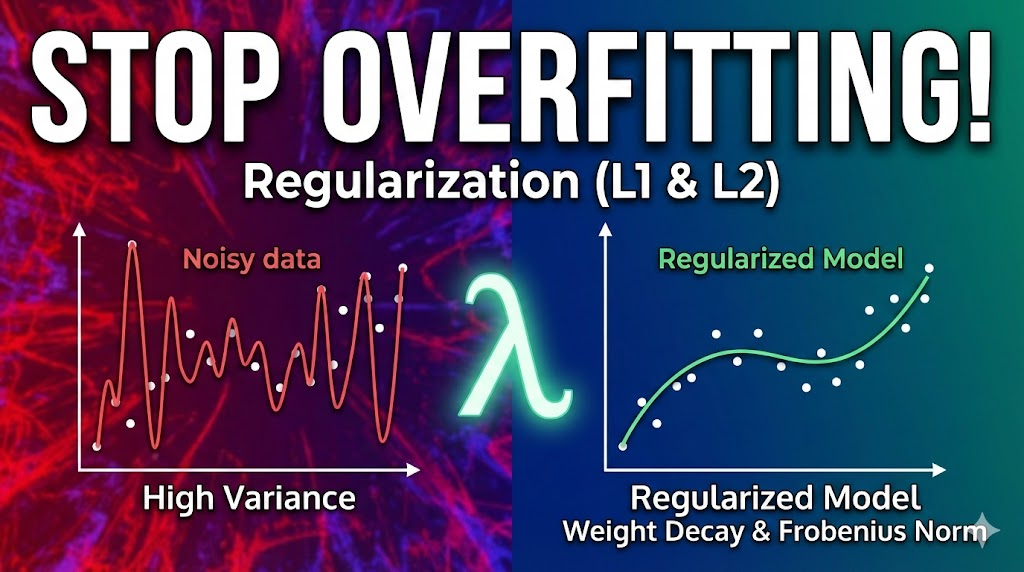
When you diagnose that your neural network has a high variance problem (overfitting), regularization should be one of the first techniques you try. While getting more training data is also effective, it’s often:
- Expensive to collect
- Time-consuming to acquire
- Sometimes impossible to obtain
Regularization is your most practical weapon against overfitting, and it works by adding a penalty for model complexity.
L2 Regularization for Logistic Regression
Standard Logistic Regression Cost Function
Recall the standard cost function for logistic regression:
\[J(w, b) = \frac{1}{m} \sum_{i=1}^{m} \mathcal{L}(\hat{y}^{(i)}, y^{(i)})\]Where:
- $w \in \mathbb{R}^{n_x}$ is the weight vector (parameter vector)
- $b \in \mathbb{R}$ is the bias (scalar)
- $m$ is the number of training examples
- $\mathcal{L}$ is the loss function for individual predictions
Adding L2 Regularization
To add L2 regularization, modify the cost function:
\[J(w, b) = \frac{1}{m} \sum_{i=1}^{m} \mathcal{L}(\hat{y}^{(i)}, y^{(i)}) + \frac{\lambda}{2m} \|w\|_2^2\]Where the regularization term is:
\[\frac{\lambda}{2m} \|w\|_2^2 = \frac{\lambda}{2m} \sum_{j=1}^{n_x} w_j^2 = \frac{\lambda}{2m} w^T w\]Components:
- $\lambda$ is the regularization parameter (hyperparameter to tune)
- $|w|_2^2$ is the squared L2 norm (Euclidean norm) of $w$
- This is called L2 regularization because it uses the L2 norm
Why Only Regularize $w$, Not $b$?
Short answer: $b$ is just one parameter, while $w$ is high-dimensional.
Detailed explanation:
| Parameter | Dimensionality | Impact |
|---|---|---|
| $w$ | $n_x$-dimensional vector | Contains most parameters |
| $b$ | Single scalar | Just 1 parameter |
Reasoning:
- In high-variance problems, $w$ has many parameters (potentially thousands or millions)
- Adding $\frac{\lambda}{2m} b^2$ would have negligible impact
- In practice, regularizing only $w$ works just as well
You can include $b$ if you want, but it’s not standard practice and won’t make much difference.
L1 vs L2 Regularization
L1 Regularization (Less Common)
\[J(w, b) = \frac{1}{m} \sum_{i=1}^{m} \mathcal{L}(\hat{y}^{(i)}, y^{(i)}) + \frac{\lambda}{m} \|w\|_1\]Where:
\[\|w\|_1 = \sum_{j=1}^{n_x} |w_j|\]Properties of L1 regularization:
- Makes $w$ sparse (many weights become exactly zero)
- Can be used for feature selection (non-zero weights indicate important features)
- Helps with model compression (fewer non-zero parameters to store)
In practice: L1 regularization is used much less often than L2.
Why L1 isn’t popular:
- Model compression benefit is marginal
- Doesn’t prevent overfitting as effectively as L2
- Creates computational challenges (non-differentiable at zero)
L2 Regularization (Most Common)
\[J(w, b) = \frac{1}{m} \sum_{i=1}^{m} \mathcal{L}(\hat{y}^{(i)}, y^{(i)}) + \frac{\lambda}{2m} \|w\|_2^2\]Why L2 is preferred:
- ✅ More effective at preventing overfitting
- ✅ Smooth, differentiable everywhere
- ✅ Works well with gradient descent
- ✅ Strong theoretical foundations
Comparison Table
| Aspect | L1 Regularization | L2 Regularization |
|---|---|---|
| Formula | $\frac{\lambda}{m} \sum \vert w_j \vert$ | $\frac{\lambda}{2m} \sum w_j^2$ |
| Result | Sparse weights (many zeros) | Small but non-zero weights |
| Use case | Feature selection, compression | Preventing overfitting |
| Popularity | Less common | Most common |
| Optimization | Non-smooth | Smooth, easy to optimize |
The Regularization Parameter $\lambda$
What is $\lambda$?
Definition: $\lambda$ (lambda) controls the tradeoff between:
- Fitting the training data well (low training error)
- Keeping weights small (preventing overfitting)
How to Choose $\lambda$
Process: Use your dev set (hold-out cross-validation) to tune $\lambda$
Strategy:
- Try various values: $\lambda \in {0, 0.01, 0.1, 1, 10, 100}$
- Train model with each $\lambda$
- Evaluate on dev set
- Choose $\lambda$ that gives best dev set performance
Effect of Different $\lambda$ Values
| $\lambda$ Value | Effect on Weights | Training Error | Dev Error | Problem |
|---|---|---|---|---|
| $\lambda = 0$ | No regularization | Very low | High | Overfitting |
| $\lambda$ too small | Weak regularization | Low | High | Still overfitting |
| $\lambda$ optimal | Balanced | Low | Low | ✅ Just right |
| $\lambda$ too large | Weights too small | High | High | Underfitting |
Python Implementation Note
⚠️ Important: lambda is a reserved keyword in Python!
Solution: Use lambd (without the ‘a’) in code
# Correct Python syntax
lambd = 0.01  # Regularization parameter

# Wrong - will cause syntax error
lambda = 0.01  # Reserved keyword!
L2 Regularization for Neural Networks
Neural Network Cost Function
For a neural network with $L$ layers:
Standard cost function:
\[J(W^{[1]}, b^{[1]}, \ldots, W^{[L]}, b^{[L]}) = \frac{1}{m} \sum_{i=1}^{m} \mathcal{L}(\hat{y}^{(i)}, y^{(i)})\]With L2 regularization:
\[J = \frac{1}{m} \sum_{i=1}^{m} \mathcal{L}(\hat{y}^{(i)}, y^{(i)}) + \frac{\lambda}{2m} \sum_{l=1}^{L} \|W^{[l]}\|_F^2\]The Frobenius Norm
The regularization term uses the Frobenius norm of weight matrices:
\[\|W^{[l]}\|_F^2 = \sum_{i=1}^{n^{[l]}} \sum_{j=1}^{n^{[l-1]}} (W_{ij}^{[l]})^2\]Where:
- $W^{[l]}$ is the weight matrix for layer $l$
- $W^{[l]} \in \mathbb{R}^{n^{[l]} \times n^{[l-1]}}$
- $n^{[l]}$ = number of units in layer $l$
- $n^{[l-1]}$ = number of units in layer $l-1$
Why “Frobenius norm”?
For arcane linear algebra reasons, the sum of squared elements of a matrix is called the Frobenius norm, not the L2 norm of a matrix. It’s denoted with subscript $F$: $|\cdot|_F$
Intuition: It’s just the sum of all squared elements in the matrix—nothing mysterious!
Complete Regularization Term
Summing across all layers:
\[\text{Regularization term} = \frac{\lambda}{2m} \sum_{l=1}^{L} \sum_{i=1}^{n^{[l]}} \sum_{j=1}^{n^{[l-1]}} (W_{ij}^{[l]})^2\]Implementing Regularized Gradient Descent
Without Regularization (Standard Update)
Step 1: Compute gradient using backpropagation
\[dW^{[l]} = \frac{\partial J}{\partial W^{[l]}} \quad \text{(from backprop)}\]Step 2: Update weights
\[W^{[l]} := W^{[l]} - \alpha \cdot dW^{[l]}\]With L2 Regularization (Modified Update)
Step 1: Compute gradient with regularization term
\[dW^{[l]} = \frac{\partial J}{\partial W^{[l]}} + \frac{\lambda}{m} W^{[l]}\]Step 2: Update weights (same formula as before)
\[W^{[l]} := W^{[l]} - \alpha \cdot dW^{[l]}\]Expanding the Update Rule
Substituting the modified gradient:
\[W^{[l]} := W^{[l]} - \alpha \left( \frac{\partial J_{\text{original}}}{\partial W^{[l]}} + \frac{\lambda}{m} W^{[l]} \right)\]Rearranging:
\[W^{[l]} := W^{[l]} - \alpha \frac{\lambda}{m} W^{[l]} - \alpha \frac{\partial J_{\text{original}}}{\partial W^{[l]}}\]Factoring out $W^{[l]}$:
\[W^{[l]} := \left(1 - \alpha \frac{\lambda}{m}\right) W^{[l]} - \alpha \frac{\partial J_{\text{original}}}{\partial W^{[l]}}\]Why It’s Called “Weight Decay”
The Key Observation
Looking at the factored form:
\[W^{[l]} := \underbrace{\left(1 - \alpha \frac{\lambda}{m}\right)}_{\text{Decay factor}} W^{[l]} - \alpha \frac{\partial J_{\text{original}}}{\partial W^{[l]}}\]The decay factor: $(1 - \alpha \frac{\lambda}{m}) < 1$
What’s Happening
Before applying the gradient update, weights are multiplied by a number slightly less than 1:
| Component | Value | Effect |
|---|---|---|
| Learning rate | $\alpha$ = 0.01 | Small number |
| Regularization | $\lambda$ = 0.01 | Small number |
| Training size | $m$ = 10,000 | Large number |
| Decay factor | $1 - \frac{0.01 \times 0.01}{10000} \approx 0.999999$ | Slightly less than 1 |
Example with typical values:
- $\alpha = 0.01$
- $\lambda = 0.01$
- $m = 10,000$
- Decay factor = $1 - \frac{0.01 \times 0.01}{10,000} = 0.999999$
Each iteration, weights are multiplied by 0.999999 before the gradient update—they decay slightly!
The Two-Step Process
Step 1 (Weight Decay): Shrink weights slightly
\[W^{[l]} := 0.9999 \cdot W^{[l]}\]Step 2 (Gradient Update): Apply gradient descent as usual
\[W^{[l]} := W^{[l]} - \alpha \frac{\partial J}{\partial W^{[l]}}\]This is why L2 regularization is also called “weight decay”—it literally decays (shrinks) the weights on each iteration!
Implementation Summary
Logistic Regression
# Cost function with L2 regularization
J = (1/m) * np.sum(losses) + (lambd/(2*m)) * np.sum(w**2)

# Gradient with regularization
dw = (1/m) * np.dot(X, (A - Y).T) + (lambd/m) * w

# Update
w = w - alpha * dw
b = b - alpha * db
Neural Network
# Cost function with L2 regularization
L2_regularization = 0
for l in range(1, L+1):
    L2_regularization += np.sum(np.square(W[l]))

J = (1/m) * np.sum(losses) + (lambd/(2*m)) * L2_regularization

# Gradient for layer l
dW[l] = (1/m) * np.dot(dZ[l], A[l-1].T) + (lambd/m) * W[l]

# Update
W[l] = W[l] - alpha * dW[l]
b[l] = b[l] - alpha * db[l]
Key Code Pattern
The pattern for regularized gradient descent is always:
# 1. Compute gradient from backprop
dW = backprop_gradient(...)

# 2. Add regularization term
dW = dW + (lambd/m) * W

# 3. Update weights
W = W - alpha * dW
Key Takeaways
- First line of defense: Regularization should be your first try when facing overfitting
- L2 most common: L2 regularization is far more popular than L1 in practice
- Regularization term: Add $\frac{\lambda}{2m} |W|^2$ to cost function
- Lambda is hyperparameter: Tune $\lambda$ using dev set, typical values: 0.01 to 10
- Don’t regularize bias: Only regularize $w$ or $W$, not $b$ (negligible impact)
- Frobenius norm: For matrices, use squared Frobenius norm = sum of all squared elements
- Modified gradient: Add $\frac{\lambda}{m} W$ to gradient from backprop
- Weight decay: L2 regularization shrinks weights by factor $(1 - \alpha\frac{\lambda}{m})$
- Python keyword: Use
lambdin code, notlambda - Sparse vs small: L1 makes weights sparse (zeros), L2 makes weights small
- All layers: Apply regularization to all weight matrices in neural network
- Simple implementation: Just modify gradient computation and cost function
- Tradeoff tuning: $\lambda$ controls training fit vs weight size tradeoff
- Computational cost: Minimal—just one extra term in gradient