Last modified: Jan 31 2026 at 10:09 PM • 3 mins read
Examine Cloud-Native Apps
Table of contents
- What Is Cloud-Native?
- Cloud Infrastructure Service Model
- Benefits of Cloud-Native Applications
- Key Takeaways
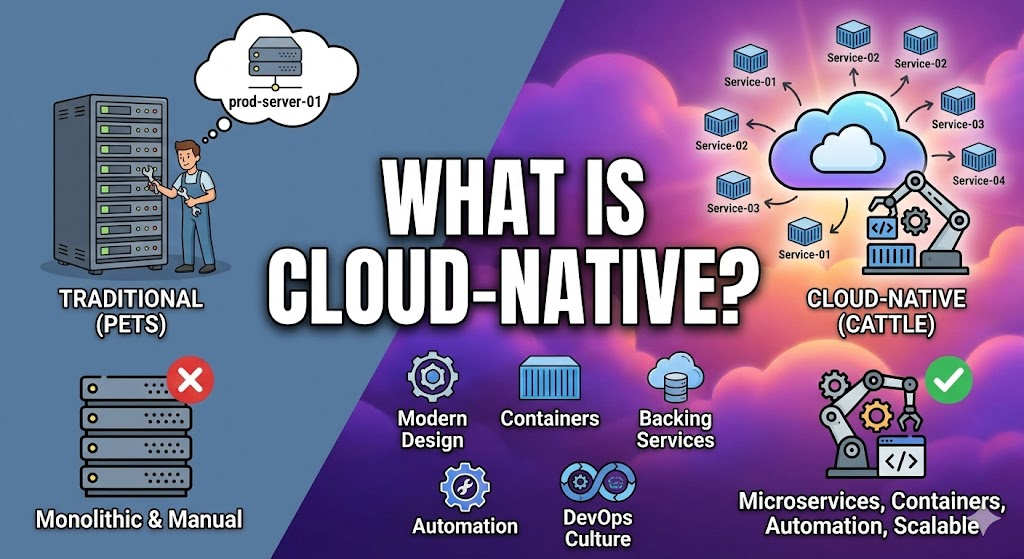
What Is Cloud-Native?
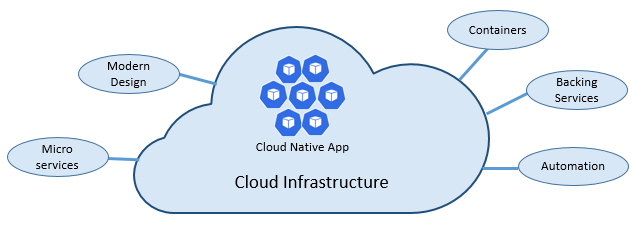
The speed and agility of cloud-native derives from many factors. Foremost is cloud infrastructure, but there are five other foundational pillars that provide the bedrock for cloud-native systems:
- Modern design - Microservices architecture
- Containers - Lightweight, portable packaging
- Backing services - Managed cloud services
- Automation - CI/CD and infrastructure as code
- DevOps culture - Collaboration and shared responsibility
Cloud Infrastructure Service Model
Cloud-native systems take full advantage of the cloud service model. They’re designed to thrive in a dynamic, virtualized cloud environment, making extensive use of Platform as a Service (PaaS) compute infrastructure and managed services.
Key Principle: Disposable Infrastructure
Cloud-native treats the underlying infrastructure as disposable - provisioned in minutes and resized, scaled, or destroyed on demand via automation.
Pets vs. Cattle: A Comparison
The difference between traditional and cloud-native infrastructure can be understood through the “pets vs. cattle” analogy:
| Aspect | Pets (Traditional) | Cattle (Cloud-Native) |
|---|---|---|
| Identity | Named servers (e.g., “prod-server-01”) | System identifiers (e.g., “Service-01”) |
| Care | Manually maintained and repaired | Automatically replaced when unhealthy |
| Scaling | Vertical (add resources to same machine) | Horizontal (add more instances) |
| Failure Impact | Everyone notices, requires intervention | Automatic replacement, minimal impact |
| Updates | Modified and patched in place | Destroyed and replaced with new version |
| Infrastructure | Mutable (changed over time) | Immutable (never modified after creation) |
The Cattle Model in Practice
In the commodities (cattle) model:
- Each instance is provisioned as a virtual machine or container
- All instances are identical and interchangeable
- Instances receive system identifiers rather than meaningful names
- Failed or outdated instances are destroyed and replaced automatically
- The application continues running regardless of individual instance lifecycle
Azure Support: The Azure cloud platform supports this highly elastic infrastructure with automatic scaling, self-healing, and monitoring capabilities.
Benefits of Cloud-Native Applications
Cloud-native applications are built to take advantage of cloud computing models to increase speed, flexibility, and quality while reducing deployment risks.
Core Benefits
| Benefit | Description |
|---|---|
| Resilient | Designed to be loosely coupled and distributed - if one component fails, the application continues to function |
| Elastic | Scale out to meet demand, scale in to reduce costs, or scale to zero when not in use |
| Observable | Built-in monitoring capabilities for health and performance tracking |
| Automated | Build, test, and deploy quickly and reliably through automation |
Deployment and Operations
| Benefit | Description |
|---|---|
| Portable | Run in the cloud, on-premises, or in hybrid environments |
| Secure | Built-in security practices protect data and customers |
| Composable | Built from modular components that can be reused across applications |
| Managed | Focus on building applications instead of managing infrastructure |
Development and Team Benefits
| Benefit | Description |
|---|---|
| Modern | Leverage the latest technologies and best practices |
| Open | Use open-source software and avoid vendor lock-in |
| Collaborative | Enable team-based development and shared ownership |
| Agile | Respond quickly to business changes and customer needs |
| Innovative | Adopt cutting-edge technologies and development practices |
Business Value
| Benefit | Description |
|---|---|
| Cost-effective | Pay only for resources you use |
| Sustainable | Reduce environmental impact through efficient resource usage |
| Data-driven | Use data to make informed decisions and improve applications |
| Inclusive | Build accessible applications for everyone |
Key Takeaways
- Cloud-native applications embrace disposable infrastructure rather than long-lived servers
- The cattle model (horizontal scaling of identical instances) replaces the traditional pets model (vertical scaling of named servers)
- Cloud-native provides 17 key benefits across resilience, operations, development, and business value
- Azure provides the platform capabilities needed for cloud-native success: automatic scaling, self-healing, and comprehensive monitoring